
How to Read the World
Scrupulosity, Biblicism, Nouthetic Counseling, and St. Paul in the Areopagus

I recently for the first time ran into a piece advocating an approach to treating Obsessive Compulsive Disorder/scrupulosity which struck me as so misguided and so likely to result in harm that I felt the need to slightly crash out about it on Twitter, and Alastair pointed out to me that crashing out about it on Substack would be more effective.
The piece is titled Fighting the Respectable Sin of Intrusive Thoughts. It’s by Matthew Statler and is published on the website of an organization called the Association of Certified Biblical Counselors, which promotes a methodology that I hadn’t really heard of before, called nouthetic counseling. I don’t know enough about it to describe it well, and I hesitate to characterize it in a way that might end up being a strawman. But I can describe what the piece advised regarding how to deal with scrupulosity or OCD.
The title indicates the approach. The author thinks of scrupulosity/OCD as primarily a matter of intrusive blasphemous or sexual thoughts, and understands these to be the result of concupiscenece, examples of the “first motions” towards sin: he takes an intrusive sexual thought in the scrupulosity sense to be the same kind of thing as, eg, the beginning of a temptation to commit adultery. He prescribes repentance, prayer, Bible reading. He anti-prescribes cognitive behavioral therapy, CBT, which is the gold standard OCD/scrupulosity treatment.

In cognitive behavioral therapy, one uses one’s reason to choose not to engage with obsessive thoughts, to choose not to respond to them with the compulsions (mental or physical) which promise relief. Over time, this habituation – this use of the immaterial reason and will to “write downwards” onto the brain – changes the structure and neurochemistry of the brain so that it becomes much, much easier to dismiss these thoughts. Frequently, this leads to full or nearly full relief of the obsessive anxiety. It works. It works really well.
Intrusive blasphemous or sexual thoughts aren’t part of my experience of scrupulosity – mine had more to do with feeling guilty about things that no one rational would say were sins, and being unable to let go of that; or feeling like I had to figure out theological questions, not being able to put them aside. But for those who do suffer from the intrusive sexual/blasphemous thoughts version, those thoughts are unrelated to temptations of the normal kind. Instead, they serve as the “worst case scenario” moral threat which in a secular person might be “if I don’t wash my hands seven times in just the right way I might give my child hantavirus and she’ll die and it will be my fault.” The obsession in that form of classic OCD is the worry that you might give your child hantavirus and she’d die and you would be guilty of her death by negligence; the compulsion would be to wash your hands. People with OCD/scrupulosity often toggle back and forth between obsessions with compulsive behavior meant to alleviate the obsessions, and pure obsession: being unable to let go of a thought, ruminating on it. In that case the rumination itself becomes the compulsion: you feel like, if you just think it through again, you’ll be able to let it go.
Both in the case of behavioral compulsions and the compulsion to ruminate, acting on the compulsion only feeds the cycle. Which is why the prescription of the author of the piece – pray, read the Bible, think correctly in particular ways – will very predictably become a compulsion for the person suffering from ruminative scrupulosity focused on intrusive thoughts. The author is, inadvertently, chiming in with the voice of the disease and prescribing the same kind of solution that the disease wants you to try. Take these thoughts seriously, both the nouthetic counselor and scrupulosity itself say. They are important. You can’t just ignore them. They say something about you. They are meaningful. You need to do something to counter them and make yourself morally safe.
Of course prayer and Bible reading are in general wonderful. So is auricular confession. These are ordinary means of grace. But as many confessors have understood, they can also become part of a sort of messed-up system of anxiety management rather than genuine spiritual growth, and in that case, the solution isn’t: pray more, and perfectly; make a more perfect act of faith because you probably did it wrong; read these particular verses and don’t stop thinking about them; read them and have the right kind of ritual feelings and thoughts about them; confess again because you probably forgot something. Instead the solution is: stop taking your anxiety seriously. Stop taking it as giving you good information about your spiritual state. Stop doing the things that you feel you need to do to make yourself morally safe. Instead, go touch grass and trust Jesus.
There is one short way to describe the problem with the nouthetic counseling approach as proposed in the piece: it essentially tells sufferers to agree with the disease. Similarly to Freudian approaches to OCD, it ascribes profound, intense significance to the intrusive thoughts of OCD, the moral threats it makes. By categorizing ruminations and intrusive thoughts as proto-sins, as things to take seriously and address rather than things to dismiss as unrelated to reality and as mental flotsam and jetsam, someone practicing at least this form of nouthetic counseling is allying himself with those thoughts. That is a dangerous thing to do. As sufferers of this condition know, habituation works. In both directions. If you habitually ascribe deep significance to the thoughts and feel the need to combat them, they will get stronger. The nouthetic counseling approach is in fact something like CBT but inverted such that it takes advantage of the power of habituation to make people worse.
So that’s the short way. But there is a longer way to think about these things, and I think it is worthwhile to examine.
CBT done properly – done in the spirit of “touch grass”-- works marvelously well. CBT and Exposure and Response Prevention are the gold standard OCD/scrupulosity treatments because they echo not just the best natural science but also some of the oldest spiritual wisdom. Practitioners of these methods must act as though they understand two things: 1. Our thoughts, wills, and feelings are related to though not identical to our bodies and brains; and 2. Our thoughts and feelings can be deceiving; they don’t necessarily reflect spiritual or material reality. You don’t have to believe everything you think, or feel.
The author dismisses CBT as, essentially, a modern materialist methodology which rejects the Biblical worldview. But here’s the thing: the Bible is not a self-enclosed reality which we must exclusively learn from. Instead, the Bible is a set of inspired books written by human beings who lived in the real world. The world that the Bible describes is the real world, this same world that we now live in. Throughout the Bible, and particularly explicitly in the Book of Proverbs, we are instructed to look outside the Bible for wisdom, as well as inside it: to study and contemplate the natural world, the patterns of the cosmos, the patterns of human relationships and of human psychology. That’s why natural theology and Biblical theology talk to each other so easily, and why what one might call “natural counselling” and “Biblical counseling” can and should talk to each other easily too.
Indeed, Aaron Beck and Albert Ellis, the originators of CBT, both talked extensively about being inspired primarily by Stoic philosophy and the virtue ethics tradition; they understood themselves to be promoting a humanistic method, one that recognized our rational nature, against the purely mechanistic behaviorism of the uber-materialist BF Skinner.
“This principle,” Ellis wrote of the basic idea of CBT,
which I have inducted from many psychotherapeutic sessions with scores of patients during the last several years, was originally discovered and stated by the ancient Stoic philosophers, especially Zeno of Citium (the founder of the school), Chrysippus, Panaetius of Rhodes (who introduced Stoicism into Rome), Cicero, Seneca, Epictetus, and Marcus Aurelius. The truths of Stoicism were perhaps best set forth by Epictetus, who in the first century A.D. wrote in the Enchiridion: “Men are disturbed not by things, but by the views which they take of them.
Beck concurred: “The philosophical origins of cognitive therapy can be traced back to the Stoic philosophers, particularly Zeno of Citium, Chrysippus, Cicero, Seneca, Epictetus, and Marcus Aurelius.”
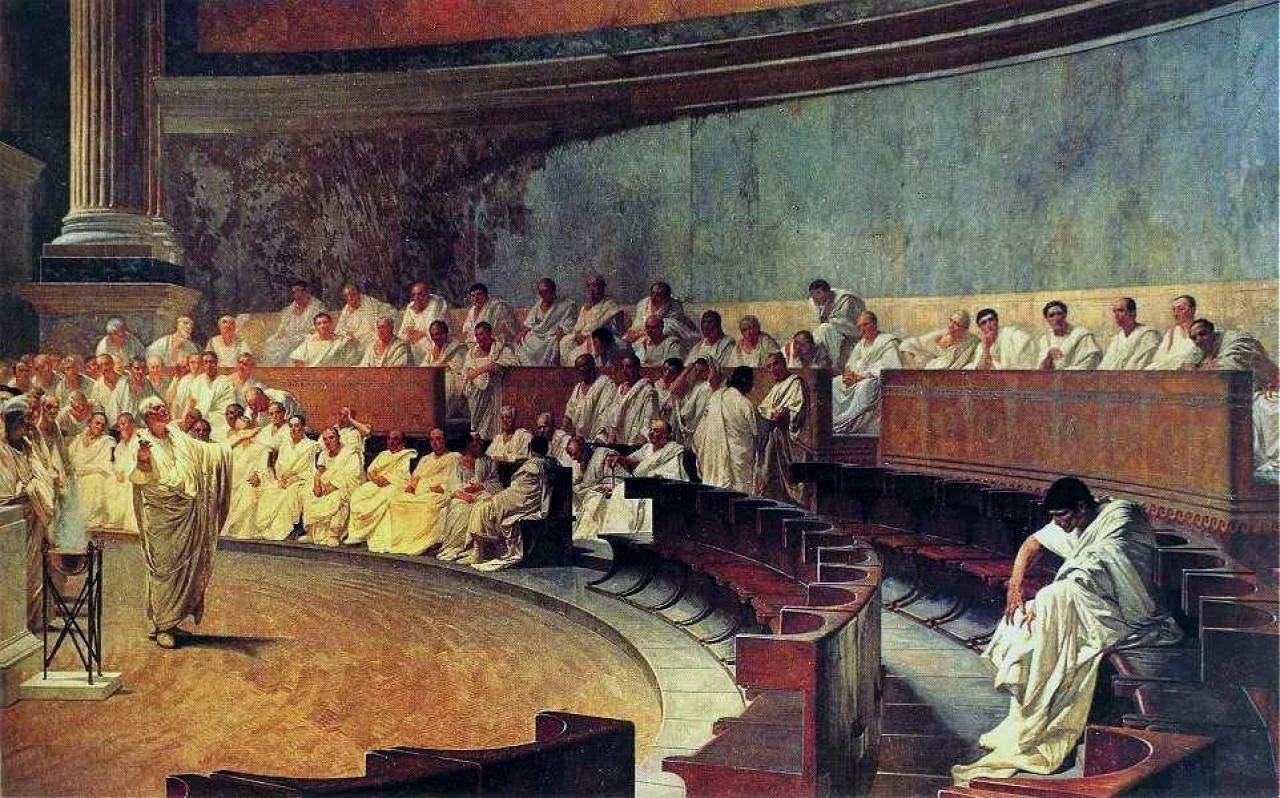
Surely many contemporary CBT practitioners are secular materialists, though the name of their discipline betrays that it is the study of the psyche, the soul. But the philosophy they were interacting with was not based in what is now thought of as materialism: the Stoics were, famously, at war with the materialist Epicureans and with the Epicurean Lucretius, whose On the Nature of Things is the first great materialist manifesto. BF Skinner would have loved it. Indeed the similarities between Skinner’s mechanistic behaviorism and Epicureanism hasn’t gone unnoted in the academic literature.
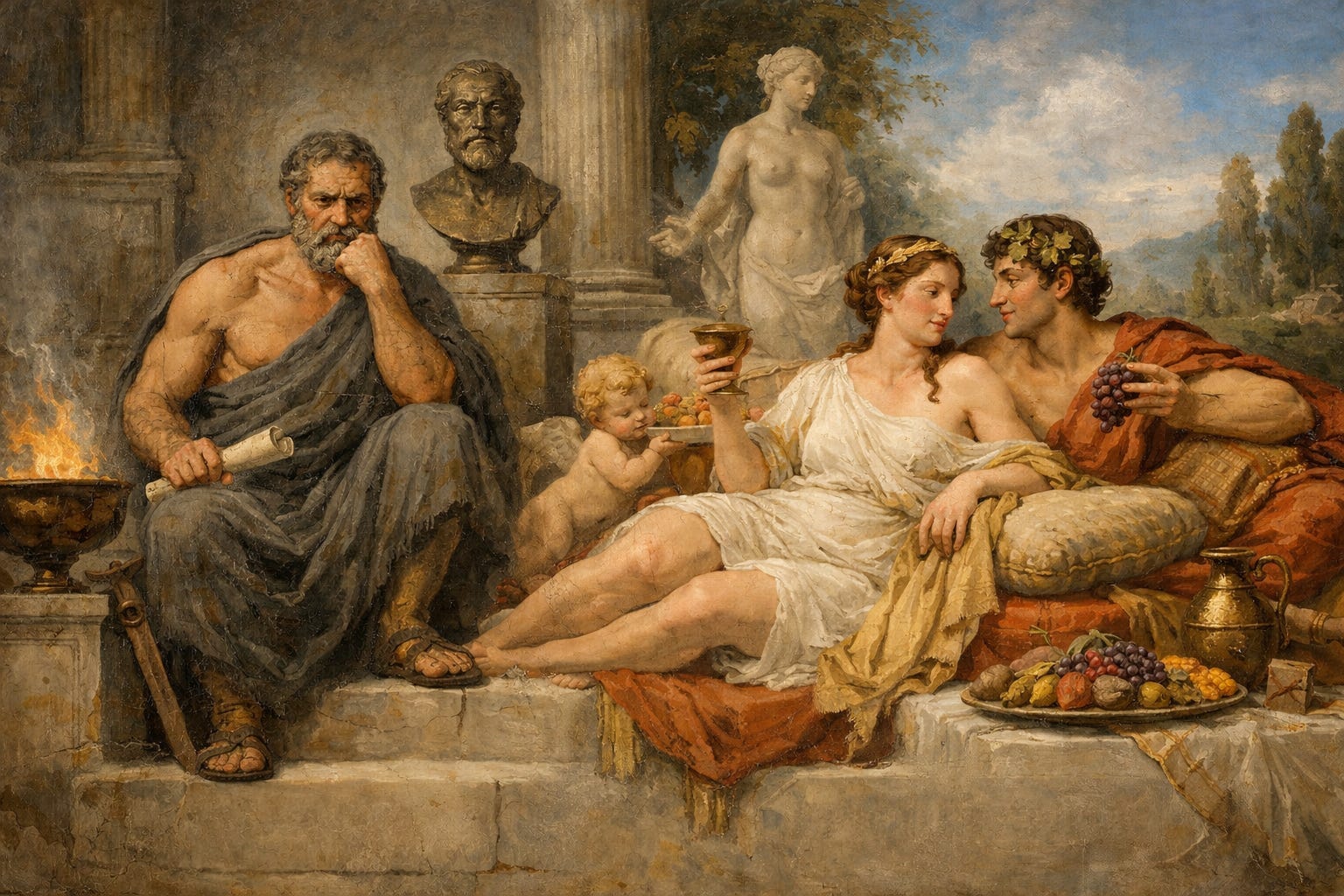
Were the Stoics theists? Certainly by the time St Paul went to Athens many were. The Stoicism of his time was in part mashed up with Platonism; the Stoic belief that to live well is to align our actions with Logos, the divine immaterial rational principle governing the universe, is unavoidable. And at the origin, Lucretius certainly counted himself among Stoicism’s cultured despisers because he understood himself to be an atheist as against their theism. He is in fact extremely bitchy in On the Nature of Things:
Nor to follow every single atom, one by one,
In order to perceive by what force every thing is done.
But certain people,* ignorant of matter, are at odds
With this, and think it is impossible without the gods
For Nature to create the crops and alternate the seasons
In such convenient accordance with our human reasons,
And when they daydream it’s for our sake that the gods arrayed
Everything in the universe, these men have grossly strayed
From reason’s strait and narrow in every way. I might not know
That such a thing as atoms of matter existed -- even so,
From the very workings of the skies above I would be bold
And claim -- a deduction many other examples would uphold --
In no way was the universe made by the power of God
For our sake, when the universe stands so profoundly flawed.
I’ll clarify that to you later. Meanwhile, I’ll explain
All things about the motions of the atoms that remain.
*Implied: “I’m looking at YOU, Zeno”
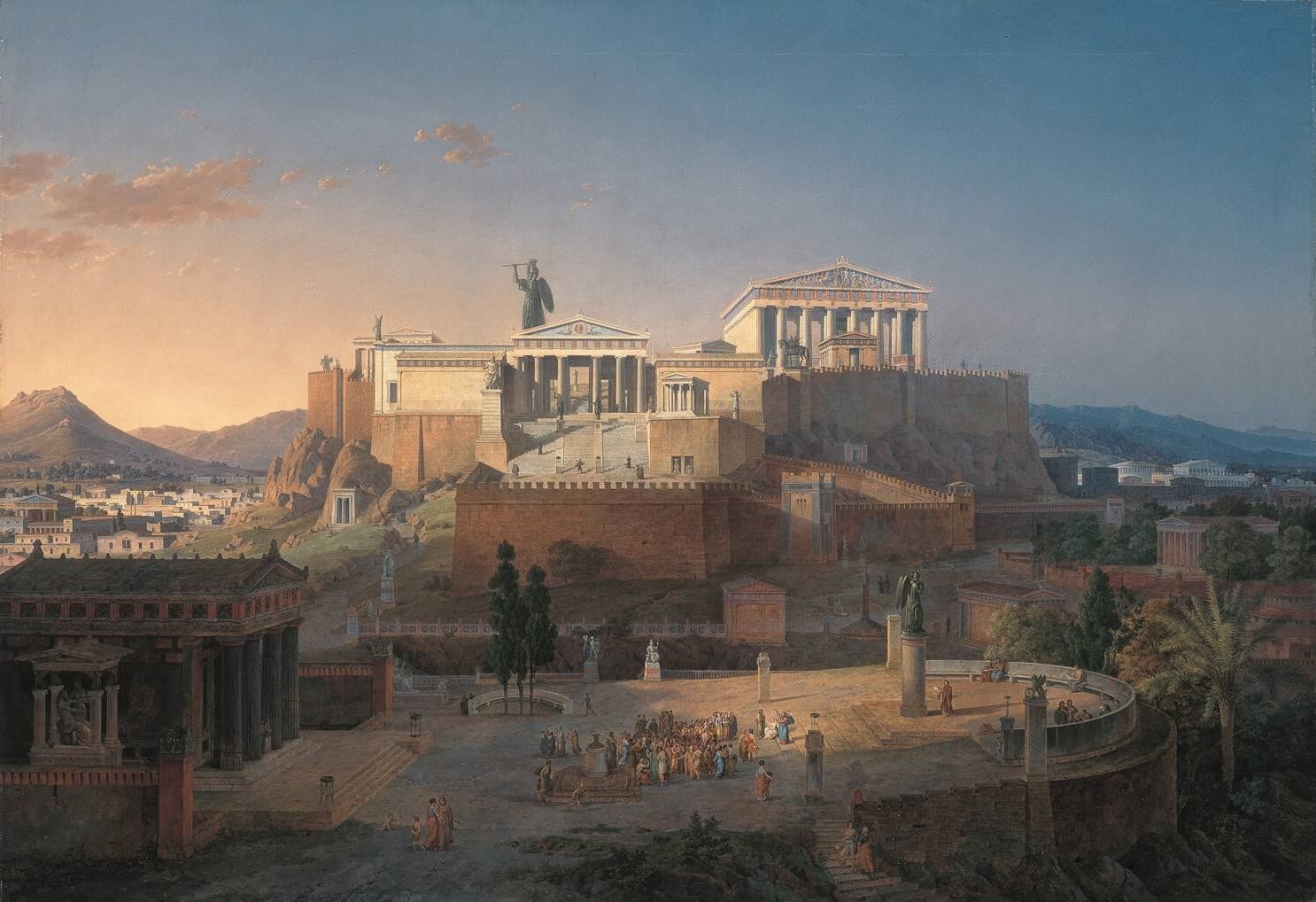
When St. Paul went to Athens – but let’s hear about that time from St. Luke. This is Acts 17:16-32. It was around the year 51 AD.
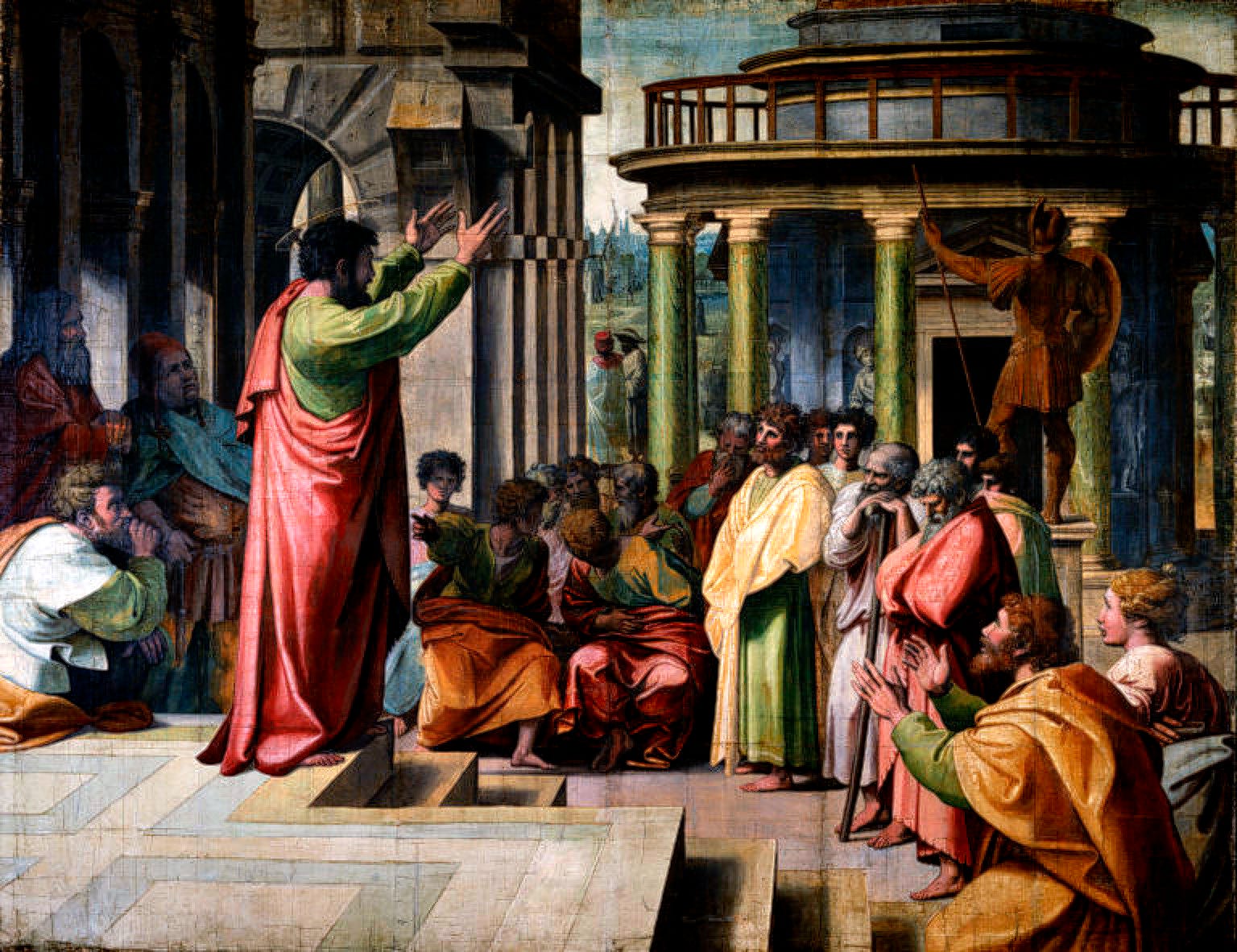
Now while Paul was waiting for them at Athens, his spirit was provoked within him as he saw that the city was full of idols. So he reasoned in the synagogue with the Jews and the devout persons, and in the marketplace every day with those who happened to be there. Some of the Epicurean and Stoic philosophers also conversed with him. And some said, “What does this babbler wish to say?” Others said, “He seems to be a preacher of foreign divinities”—because he was preaching Jesus and the resurrection. And they took him and brought him to the Areopagus, saying, “May we know what this new teaching is that you are presenting? For you bring some strange things to our ears. We wish to know therefore what these things mean.” Now all the Athenians and the foreigners who lived there would spend their time in nothing except telling or hearing something new.
So Paul, standing in the midst of the Areopagus, said: “Men of Athens, I perceive that in every way you are very religious. For as I passed along and observed the objects of your worship, I found also an altar with this inscription: ‘To the unknown god.’ What therefore you worship as unknown, this I proclaim to you. The God who made the world and everything in it, being Lord of heaven and earth, does not live in temples made by man, nor is he served by human hands, as though he needed anything, since he himself gives to all mankind life and breath and everything. And he made from one man every nation of mankind to live on all the face of the earth, having determined allotted periods and the boundaries of their dwelling place, that they should seek God, and perhaps feel their way toward him and find him. Yet he is actually not far from each one of us, for
‘In him we live and move and have our being’;
as even some of your own poets have said,
‘For we are indeed his offspring.’
Being then God’s offspring, we ought not to think that the divine being is like gold or silver or stone, an image formed by the art and imagination of man. The times of ignorance God overlooked, but now he commands all people everywhere to repent, because he has fixed a day on which he will judge the world in righteousness by a man whom he has appointed; and of this he has given assurance to all by raising him from the dead.”
Now when they heard of the resurrection of the dead, some mocked. But others said, “We will hear you again about this.” So Paul went out from their midst. 34 But some men joined him and believed, among whom also were Dionysius the Areopagite and a woman named Damaris and others with them.
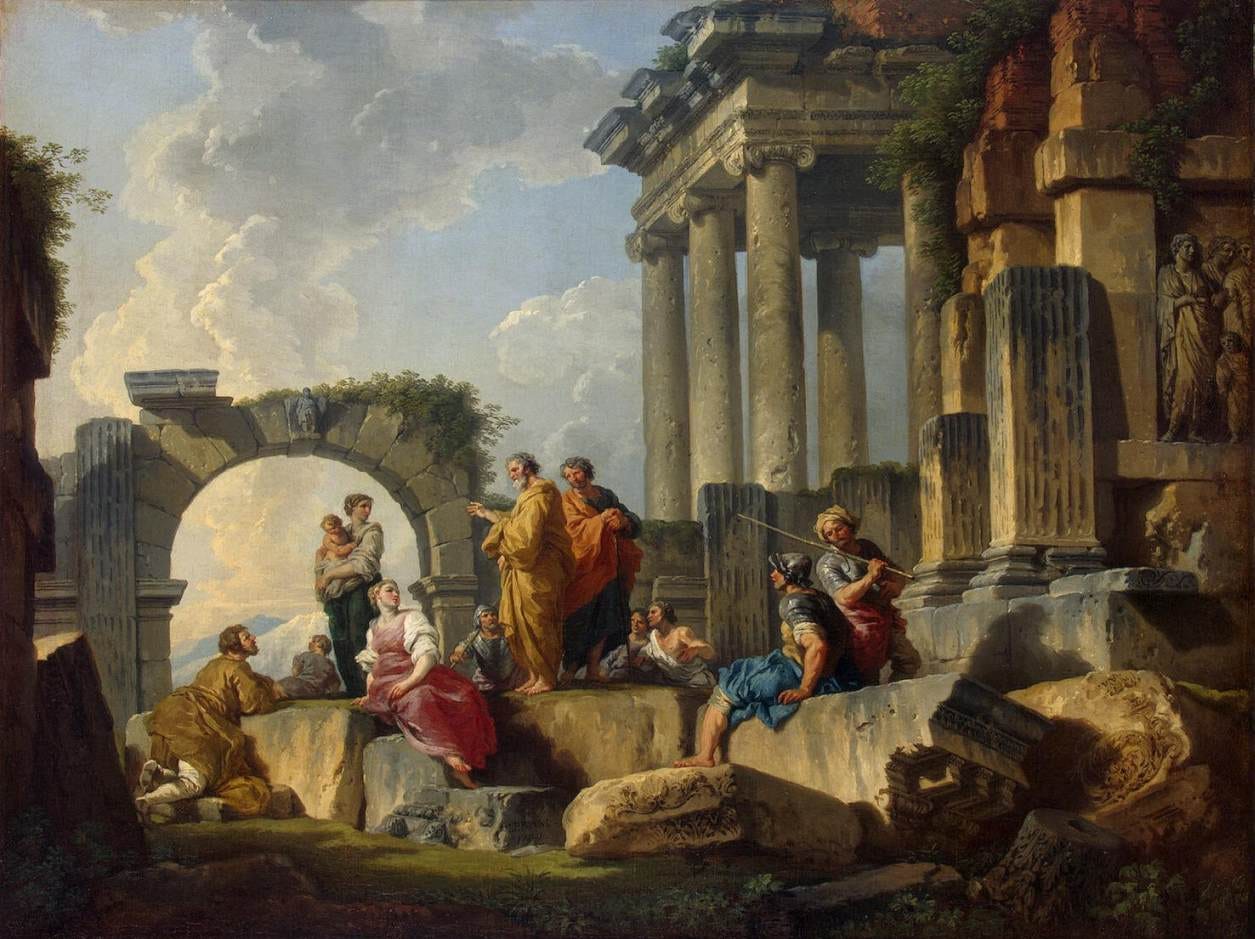
The second quote, τοῦ γὰρ καὶ γένος ἐσμέν, “for we are all his offspring,” is from the Phaenomena, a long poem by the philosopher-poet Aratus (315ish-240 BC), who was a disciple of Zeno, the founder of Stoicism. The full passage from which it’s drawn is this:
From Zeus let us begin; him do we mortals never leave unnamed; full of Zeus are all the streets and all the market-places of men; full is the sea and the havens thereof; always we all have need of Zeus. For we are also his offspring; and he in his kindness unto men giveth favourable signs and wakeneth the people to work, reminding them of livelihood. He tells what time the soil is best for the labour of the ox and for the mattock, and what time the seasons are favourable both for the planting of trees and for casting all manner of seeds. For himself it was who set the signs in heaven, and marked out the constellations, and for the year devised what stars chiefly should give to men right signs of the seasons, to the end that all things might grow unfailingly. Wherefore him do men ever worship first and last. Hail, O Father, mighty marvel, mighty blessing unto men. Hail to thee and to the Elder Race! Hail, ye Muses, right kindly, every one! But for me, too, in answer to my prayer direct all my lay, even as is meet, to tell the stars.
Of course St. Paul is not here affirming the worship of Zeus. But what the Stoics and neoplatonists had done with the worship of Zeus was to philosophize it and natural-theologize it so much that the god described in their poems and treatises resembled God, the actual transcendent Creator of all things, far more than he did the randy, easily irritated deity of the myths. It is this God whom Justin Martyr, good Platonist that he was, worshiped on the verge of his conversion, when he ran into his mysterious interlocutor on the beach at Ephesus in 130 AD: That which always maintains the same nature, and in the same manner, and is the cause of all other things – that, indeed, is God.
The first quote, ἐν αὐτῷ γὰρ ζῶμεν καὶ κινούμεθα καὶ ἐσμέν, “For in him we live, and move, and have our being,” is from the Cretica (Κρητικά) of Epimenides, the seer-poet who lived a hundred years or so before Socrates; he was a friend of Pythagoras. We know little of him and what little we know is semi-mythical, and we don’t have the full text of that work. But St. Paul clearly did: he quotes from the same poem in his letter to Titus, his “true child in the faith,” whom he has left behind to shepherd the church in Crete: “Cretans are always liars, evil beasts, lazy gluttons.”
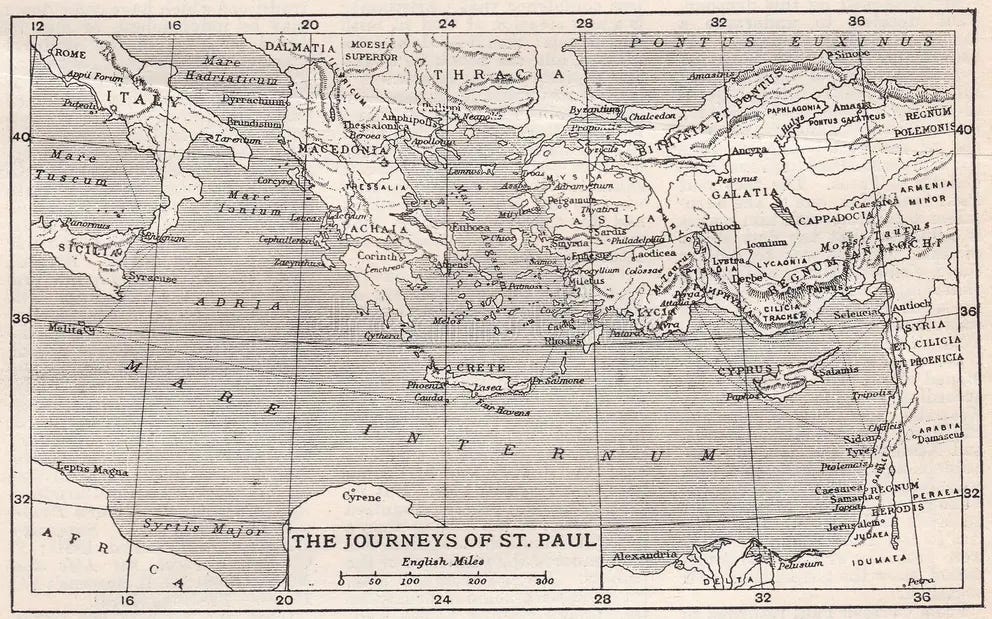
And we know too what the poem is about: it was a refutation of the claim of the Cretans that Zeus had been born on Crete, and that he had died there: that a particular ritual building on the island was in fact the tomb of the god. The character Minos, standing in for the poet, rebukes this idea as blasphemous. (The line about the character of Cretans is also a semi-joke, a deliberate paradox, as of course Epimenides is himself a Cretan.)
Though the original poem is lost, Callimachus, another poet, had in the written a sort of paraphrase, in which the relevant passage reads
πῶς καί μιν, Δικταῖον ἀείσομεν ἠὲ Λυκαῖον;
ἐν δοιῇ μάλα θυμός, ἐπεὶ γένος ἀμφήριστον.
Ζεῦ, σὲ μὲν Ἰδαίοισιν ἐν οὔρεσί φασι γενέσθαι,
Ζεῦ, σὲ δ᾿ ἐν Ἀρκαδίῃ· πότεροι, πάτερ, ἐψεύσαντο;
Κρῆτες ἀεὶ ψεῦσται·” καὶ γὰρ τάφον, ὦ ἄνα,σεῖο
Κρῆτες ἐτεκτήναντο· σὺ δ᾿ οὐ θάνες, ἐσσὶ γὰρ αἰεί.
Literally translated this is
How shall we sing of him—as lord of Dicte or of Lycaeum?
My soul is all in doubt, since debated is his birth.
O Zeus, some say that thou wert born on the hills of Ida;
others, O Zeus, say in Arcadia; did these or those, O Father, lie?
“Cretans are ever liars.” Yea, a tomb, O Lord, for thee the Cretans builded;
but thou didst not die, for thou art for ever.
In a Victorian and very Latinized English verse translation:
The Cretans, prone to falsehood, vaunt in vain,
And impious! built thy tomb on Dicte’s plain;
For Jove, th’ immortal king, shall never die,
But reign o’er men and Gods above the sky.
Working backwards, then, and working in the original lines that St. Paul had used, a suggested reconstruction of the passage of Epimenides which is clearly rattling around in his head is this:
They fashioned a tomb for you, holy and high one,
Cretans, always liars, evil beasts, idle bellies.
But you are not dead: you live and abide forever,
For in you we live and move and have our being.1
That is what the Cretans were lying about. They were claiming that the body of the god was in the tomb. They were claiming that the tomb was not empty.
Some of what we know about Epimenides comes from the third century AD biographer Diogenes Laërtius, whose Lives and Opinions of Eminent Philosophers is, everywhere we can fact-check him, remarkably reliable both in quotation and in matters of biographical fact. According to his account, plague had broken out in Athens, and the Athenians, having consulted the Oracle of Delphi, sent a ship to Crete to ask Epimenides for help. He agreed, and, coming to Athens, he brought a small flock of sheep to the Areopagus. He set the sheep wandering, and wherever one lay down, he had the spot marked, and a shrine built so that sacrifices could be made to “the unknown god,” the local divinity of that spot, known, apparently, to the sheep. This remedy worked, and the plague was lifted.

What therefore you worship as unknown, this I proclaim to you.
It is the method and teaching of natural theologians everywhere, those who, like St. Paul, like Justin Martyr, were willing to travel, to encourage others to travel, the good path of natural reason up until it reveals the shape of the One who came in the fullness of time to reveal himself as that unknown God. It is the method of those who, loving Jerusalem, love Athens as well. As Justin says in his trial before the Stoic Rusticus, the teacher of Marcus Aurelius whose representative in Ephesus he was:
We have been taught that Christ is the first-born of God, and we have declared above that he is the Word of whom every race of men were partakers; and those who lived reasonably are Christians, even though they have been thought atheists; as, among the Greeks, Socrates and Heraclitus, and men like them.…
Let me retrace my breadcrumb trail.
The author of the piece on nouthetic counseling is, surely, driven by the desire to help people who are suffering, and to help them by the help Christ offers. And I cannot read his mind. But it seems to me that the worry that some who go the biblicist route have is that if they look reality in its face – if, for example, you really listen to the person who you’re trying to help, really seek to understand his suffering with no preconceptions; if you really look at the world, really let it testify; if you go outside your own group’s contemporary understanding of what Scripture means and how it should be engaged, then you might end up an atheist.
All I can say to someone with this worry is: Trust God at least as much as Aratus did, at least as much as Epimenides. Trust him as much as Socrates did, and St. Paul, and Justin Martyr. One cannot live out Christianity by rejecting the path of wisdom in favor of the path of scripture. These are not separate paths.
Reality is robust. You don’t need to decide ahead of time how to understand everything based on a “scriptural framework.” God breathed the world into existence, not just the scriptures, and the world itself is legible. The Bible that you rightly love is more sturdy than you think it is, and is not isolated from philosophy, science, human culture. You don’t have to protect it, or yourself. You don’t have to protect your “worldview” by having a pre-decided “biblical worldview.” God is the creator of our bodies and our minds and of all things, visible and invisible.
Open the windows. Let in the air.

It was clearly a poem that St. Paul dwelt on: the Areopoagus sermon was in AD 51, and he didn’t write the Epistle to Titus until at least AD 62. For those who are interested, the Callimachus paraphrase/rewrite is here, in the Loeb edition.
Thank you! It is ironic that this supposedly ‘biblical’ approach neglects the best resources in the tradition. Personally, I’ve found Luther tremendously helpful for dealing with scrupulously/OCD. Luther makes two moves that I think help do something like Acceptance Therapy or CBT.
First, he makes the basic move you suggest of distancing himself from the thoughts going through his head. Luther does this by having a very active sense of the devil’s temptations. Thus for Luther, you can’t identify yourself with your thoughts. This is such a basic Christian idea, I’m surprised the stuff you cite doesn’t go there.
Second, Luther is able to defang the power of the ‘bad thoughts’ through his theology of grace. If you read his Table Talk he will answer scrupulous thoughts by acknowledging them and then taking comfort in God’s grace:
“So when the devil throws your sins in your face and declares that you deserve death and hell, tell him this: "I admit that I deserve death and hell, what of it? For I know One who suffered and made satisfaction on my behalf. His name is Jesus Christ, Son of God, and where He is there I shall be also!”
There is also some delightful advice in the Table Talk that flies in the face of the morbid self examination that the Biblical Counselling approach you cite recommends:
“When you are assailed by gloom, despair, or a troubled conscience should eat, drink, and talk with others. If you can find help for yourself by thinking of girl, do so.”
<3